
City Hall closes at five. The city doesn’t.
Farwell wanted residents to be able to pay a bill, report a problem or get an emergency notice without waiting for the office to open. I built the website and the workflows that made that true.
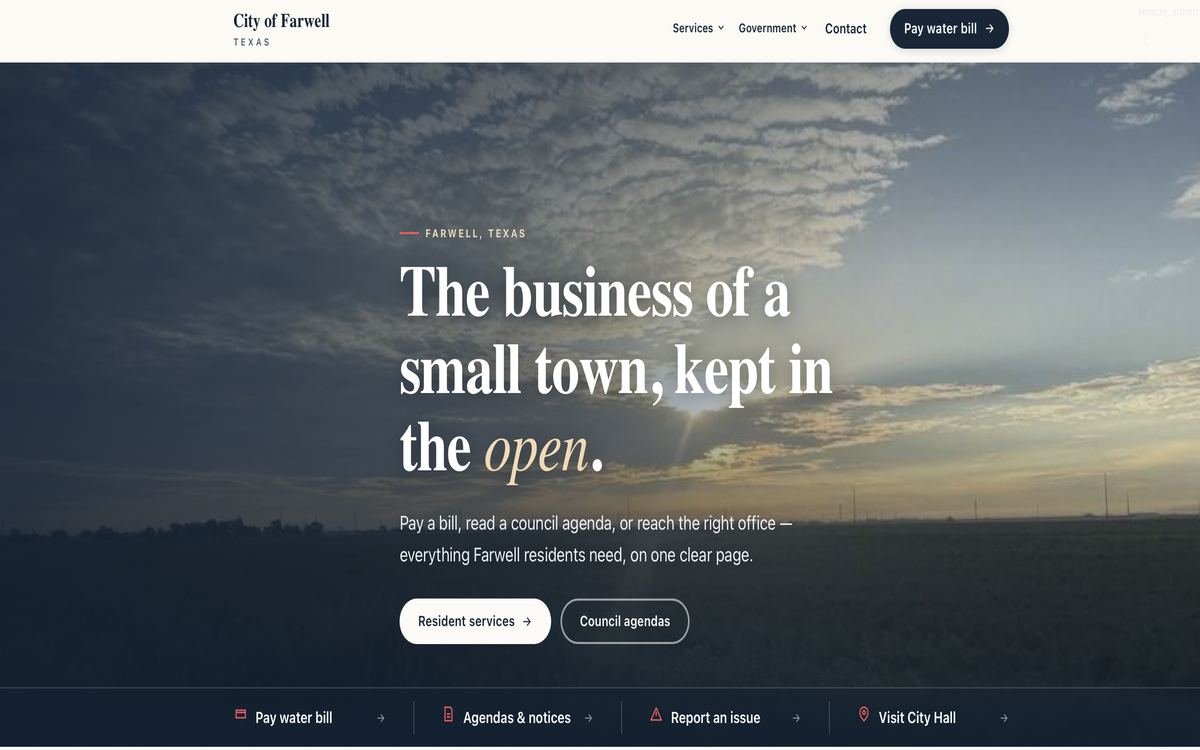
Where does a small city post an emergency notice at nine on a Friday night?
For most towns the honest answer is a social account — often one belonging to another department, on a platform that decides who sees it and when. It works until the night it matters. Farwell wanted a channel it owned outright, and that became the spine of the whole project.
Same staff. Same thirty hours. A lot more city.
A site that could tell you things, but couldn’t take anything back.
- Seven static pages — useful for reading, with nowhere to submit anything.
- Emergency updates went out through social — the only channel available at the time.
- Documents were scanned — the way almost every small city’s were before the ADA rule landed.
- Open Monday to Thursday — with a lunch closure, plus a half day Friday — and that was the whole window for anything.
A site that works while City Hall is closed.
- Report a pothole at 11pm — and you get a confirmation at 11pm. Public works looks at it inside one business day.
- Notices go out from a list the city owns — boil-water notices, outages, closures. You don’t need an account to get one.
- Every document can be read by a screen reader — because it was built that way instead of scanned from paper.
- Agendas post three business days ahead — on the website and the board, which is what the Texas Open Meetings Act has required of every Texas municipality since 1 September 2025.
Three workflows, built around what residents actually came for.
Not around the city’s org chart. The four things residents actually turn up for sit right across the bottom of the hero, so nobody has to go hunting through a menu for them.
Report an issue
A pothole, a streetlight out, a water leak. Somebody picks what it is, adds a photo if they have one, and the report goes straight to the department that handles it — along with an automatic thank-you so they know it landed. Two people get told every time, so a day off never leaves a report sitting there.
Validated and encrypted on arrival — nothing sits in plain text
Contact the city
Same routing, same acknowledgment, but for questions rather than problems. I kept it separate from reporting on purpose — different urgency, different people, and nobody has to guess which one they need.
Nothing lands in an inbox nobody is watching
City alerts
A subscriber list the city owns outright. Boil-water notices, outages and road closures go straight to people, instead of depending on whether they happen to follow the right account on the right day.
The direct answer to the Facebook problem
What these forms deliberately don’t do is replace a phone call. The report page says outright that it isn’t watched around the clock, lists the after-hours numbers for water emergencies, and tells anyone in danger to dial 911. A workflow that quietly swallows an emergency is worse than no workflow at all.
Built to the standard, not patched up to meet it later.
Every state and local government website has to meet WCAG 2.1 Level AA under the DOJ’s ADA Title II rule. Farwell was designed to it from the first wireframe, which costs a fraction of what it costs to go back and fix a finished site.
2028
The conformance date for public entities serving under 50,000 people, which includes Farwell. The city is not waiting for it.
The published accessibility statement names a person, gives an email, commits to a two-business-day reply, and sets out an escalation route — including to the Department of Justice. That is what good faith looks like written down.
And I’m still here.
Farwell doesn’t have a communications department, and a site nobody looks after is a problem again inside a year. So the city kept me on.
- Agendas and public notices posted on schedule
- Alerts written and sent when something happens
- The city’s social accounts, to the same standard
- Workflows adjusted as the city’s work changes
- New documents remediated before they go up
- Accessibility held at standard as content is added
Farwell isn’t a special case.
Tell me what your team is still doing by hand and I’ll tell you whether I can automate it, what it’d take, and roughly what it costs.