I build your website. Then I run it.
Most of the work happens after launch. Somebody has to write the posts, send the notices, and change the form when the office changes. Somebody has to patch the plugins, too — an out-of-date plugin is how most sites get broken into.
At most of the organizations I work with, nobody has that job. The content goes stale, a form quietly breaks, and nobody notices for months. The site is still up — it has just stopped doing anything for you. That is the part I stay for.
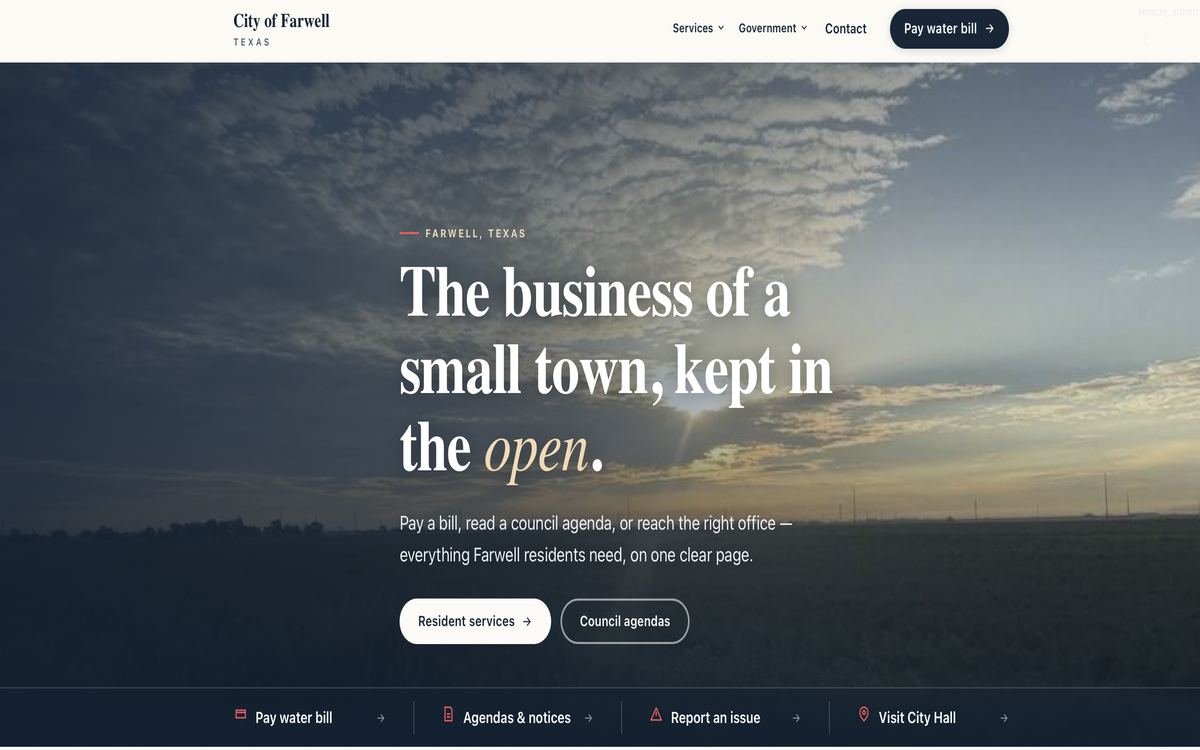
City of Farwell, Texas
A city of about 1,300 with no communications department. I built the site, three routed workflows and remediated every city document — and I have run the site, the notices and the social accounts every month since.
The build
Once, at a fixed price
Your site, your forms, and the routing behind them — scoped from a conversation about what your team is still doing by hand, not from a template.
- Forms embedded in your site, routed to the people who handle them
- An automatic confirmation to whoever submitted it, in seconds
- A notice and alert channel you own outright — email and SMS
- Sensitive submissions encrypted in transit and on arrival
- WCAG 2.1 AA on the site and on every PDF you put on it
What changes on day one: the retyping stops, and everything that comes in has somewhere to go.
What “routed” actually means
A submission does not go to one inbox. It goes where it belongs, based on what it is — and two people always get it, by email or text, so a day off never leaves something sitting. Yours gets built from what your team actually does; this is the shape of one.
The month
Ongoing, at a flat monthly fee
- Whatever your organization runs on, posted on time — event notices, agendas, blog posts, announcements
- Email and SMS alerts written and sent when something happens
- The site itself updated, and its plugins updated and patched
- Accessibility held at standard as new content goes up
- Workflows changed as the way you work changes
- One planning meeting, with me, not a portal
The person who built it is the person who runs it. Nothing waits for a ticket, and nobody has to explain the setup twice.
What you get for it: a communications function, without a hire to make, a desk to fund or a role to advertise. No long contract — thirty days’ notice ends it.
Two things you can add to the monthly.
Social management is there whenever you want it. Creative direction is different — it is hands-on, it does not scale, and I keep a small number of them running at a time.
Social management
Your accounts run to the same standard as the site — written, scheduled and posted to Facebook, Instagram and LinkedIn, with alt text on every image.
Creative direction
Someone deciding how everything looks and sounds — the mailer, the invoice, the deck for the council meeting, the webinar and the video that comes out of it. I take a small number of these at a time, so everything that goes out is something I made.
Tell me what your team is doing by hand.
I’ll tell you whether I can automate it, what it would take, and what it would cost. Before you commit to anything.