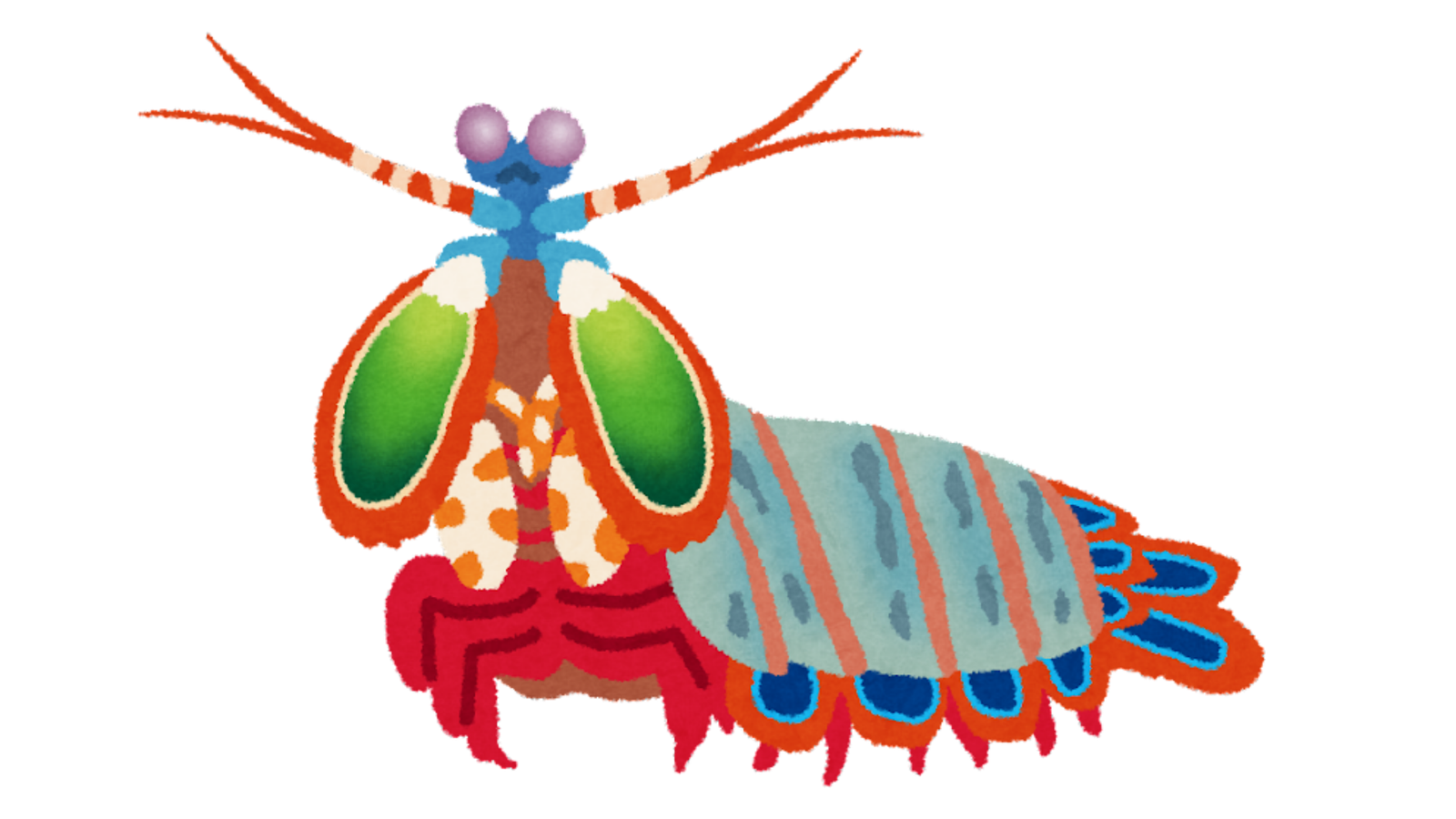
You dare approach
the Mantis Shrimp's Lair?

The shrimp is watching.
It has 16 types of eyes to watch you with.
16.

🦐 BOLD. FOOLISH. INCORRECT. 🦐
Mantis Shrimp
Nature's Most Extraordinary Animal
West of Ordinary
Stomatopoda · Est. 400 Million Years Ago
16

color receptors.
You have three.

The mantis shrimp is a four-inch marine animal that punches faster than a bullet, sees colors that don't have names, and has been at this since before trees existed.

16
Color Receptors
200mph
Strike Speed
400M
Years on Earth
Mantis shrimp
The Ocean's Best-Kept Secret
Mantis Shrimp
Meet the Animal
Chapter 01
01
Stomatopoda

Not a shrimp.
Not a mantis.
Entirely its own thing.

Mantis shrimp are stomatopods — a distinct order that split from other crustaceans 400 million years ago. They've been running a completely separate evolutionary experiment ever since, and the results are absurd in the best possible way.

Found in tropical and subtropical reefs worldwide, they're solitary, they're territorial, and they're armed. They claim a burrow and they will defend it against anything — including animals ten times their size.
Fast Facts
1,500+ known species
From tiny thumbnail-sized ones to 18-inch giants, found from Hawaii to the Red Sea to the Great Barrier Reef.
Two completely different weapons
Smashers carry calcified clubs that deliver explosive blunt force. Spearers have barbed appendages that impale fast-moving fish. Same order. Totally different nightmare.
Older than trees
The mantis shrimp lineage predates terrestrial forests by roughly 50 million years. They were already established when the first trees appeared.
Do not put your hand in their hole
Marine biologists say this more than you'd expect. They've broken fingers. They have broken aquarium glass. Respect the burrow.
Mantis Shrimp
The Strike
Chapter 02
02
The Dactyl Club

The fastest punch in the animal kingdom.

The smasher's club accelerates at 10,400 g-forces — comparable to a .22 caliber bullet. It moves so fast it creates a cavitation bubble in the water: a tiny vacuum that collapses with a secondary shockwave powerful enough to stun or kill prey even if the club misses entirely.

"It punches with the force of a rifle bullet. Then the water punches for it again."
The Numbers
200 mph / 10,400 g's
Acceleration rivaling a rifle bullet. The club unfolds from a saddle-shaped spring mechanism and releases in under 3 milliseconds.
400 lbs of force
From a four-inch animal. Proportionally equivalent to a human punching through six inches of reinforced concrete.
The cavitation bonus hit
The collapsing vacuum bubble hits up to 8,000°F for a microsecond — hotter than the surface of the sun — and delivers a second shockwave. One strike, two impacts.
200 decibels underwater
The collapse produces both a flash of light and a sound louder than a gunshot. From an animal the size of a large shrimp.
Mantis Shrimp
The Club — What NASA Found
Chapter 02
Mantis shrimp raising clubs
02 cont.
Materials Science

The club that NASA studies.

The dactyl club is made of a helicoidal fiber architecture — layers of mineralized chitin fibers rotating at a slight angle between each layer. This design distributes crack propagation in a spiral, preventing catastrophic failure under repeated high-impact loading.

Impact-resistant architecture
Studied by UC Riverside, MIT, and DARPA for applications in body armor, helmets, and aircraft panels.
Thousands of strikes without damage
The club can strike prey thousands of times without fracturing — a materials engineering problem we haven't solved in synthetic materials.
Self-regenerating between molts
The entire club regrows each time the shrimp molts. Nature built a self-healing impact weapon and called it Tuesday.
Mantis Shrimp
The Vision — Spectrum
Chapter 03
03
16 Photoreceptors

Seeing colors
without names.

Humans have 3 types of color receptors — red, green, blue. Dogs have 2. The mantis shrimp has 16, tuned across ultraviolet, visible, and near-infrared light. They also detect multiple forms of polarized light that no other animal on Earth perceives.

Visible Spectrum — Full Coverage

UVVioletBlueGreenYellowRedIR

The shrimp's 16 receptors cover the entire band above, plus polarized light you can't even conceive of.

How 16 Receptors Work
Not better at appreciating color
Surprisingly, behavioral tests show they're not better at distinguishing similar hues than humans. Instead they process color differently entirely.
Combat targeting system
Each receptor makes a fast yes/no decision independently — like a parallel processing array. No comparison needed, no lag time. Instant color ID for combat.
UV secret language
Many species produce fluorescent markings visible only in ultraviolet — patterns they can read but most predators are completely blind to. A private visual channel.
Circular polarized light
They detect circular polarized light — a form of light reflection that no other animal is known to see. Engineers are studying this for optical communications.
Mantis Shrimp
The Vision — Eye Structure
Chapter 03
MIDBAND Dorsal Ventral Trinocular compound eye
03 cont.
Eye Architecture

Each eye sees depth on its own.

The mantis shrimp eye has three regions: a dorsal hemisphere, a ventral hemisphere, and a midband — a horizontal stripe containing all 16 color receptor types. The midband is where all the magic happens.

Trinocular vision per eye
Each compound eye independently perceives depth — meaning they don't need both eyes to judge distance. They have two redundant 3D systems.
Move independently on stalks
Each eye rotates independently. They can look in completely different directions simultaneously, or focus both on the same target for enhanced precision.
Mantis Shrimp
The Life
Chapter 04
04
The Domestic Life

Monogamous.
Territorial.
Weirdly devoted.

Many mantis shrimp species mate for life. They share burrows, take turns hunting, and groom each other regularly. Some bonded pairs have been observed together for over 20 years. This is, genuinely, more functional than most human relationships.

They also raise their young together — both parents guard the eggs and the female sometimes carries them, aerating them constantly until they hatch.

Life in the Reef
20+ year partnerships
Lifelong pair bonds are well-documented across multiple species. They recognize their partners individually and seek each other out.
They glow in the dark
Several species produce brilliant fluorescent patterns under UV light — invisible to most predators but vivid to each other. Communication on a private frequency.
Extreme territoriality
They will charge animals many times their size to defend their burrow. They have been observed deterring octopuses, fish, and occasionally the hands of researchers.
They make sounds too
Some species produce low-frequency rumbles — likely used for communication and territory warnings. Violence and noise, but also love. That's the full picture.
Mantis Shrimp
The Full Picture
Chapter 05
Mantis shrimp
05
The Full Picture

Everything, all at once.

It punches at 200 mph. It sees ultraviolet light. It glows in private frequencies only its partner can read. It mates for life. It has been doing this since before trees. It is four inches long.
"It doesn't know it's extraordinary. It's just in its burrow, waiting for its mate to come home."
1,500+
Species
3ms
Strike Time
20yr
Pair Bonds
Mantis Shrimp
Why It Matters
Chapter 06
06
Real-World Impact

What we've learned
from a shrimp.

The mantis shrimp isn't just extraordinary — it's useful. Researchers worldwide have turned its biology into engineering breakthroughs that are saving lives and reshaping how we build things.

Sometimes the best technology was already invented 400 million years ago and is living quietly on a reef, waiting to punch something.

Inspired By the Mantis Shrimp
Advanced body armor
The helicoidal fiber structure of the dactyl club is being replicated in composite armor panels and helmets — providing better impact resistance at lower weight than existing materials.
Cancer detection cameras
Scientists at University of Queensland built a camera inspired by the mantis shrimp eye that can detect cancerous tissue — visible in polarized light the eye naturally perceives.
Optical communications
Its circular polarized light detection is being studied for ultra-high-speed data transmission systems — a form of light encoding that doesn't interfere with other signals.
Aircraft structural panels
Boeing and other aerospace companies have explored the club's fiber architecture for structural panels that must absorb high-energy impacts without catastrophic failure.
Mantis Shrimp
Life in the Reef
Chapter 07
07
Reef Ecosystem

Where the
mantis shrimp
calls home.

Tropical and subtropical reefs are among the most biodiverse environments on Earth — and the mantis shrimp is one of their most dominant predators. They don't wander. They own a specific burrow and they stay.

The Habitat
Depth range: 3 to 1,500 feet
Most species favor shallow reef flats and rubble zones, though some have been found at surprising depth. Wherever they are, they dig.
Burrow architects
They excavate and maintain elaborate burrows in sand, rubble, or coral rock — reinforcing the walls, keeping them clean, and defending them for life.
Tropical Indo-Pacific to Caribbean
Found across the world's warmest reef systems — from Hawaii and Australia to East Africa, the Red Sea, and the Caribbean.
Apex of the microreef
Within their territory they are the top predator — hunting crabs, snails, clams, fish, and occasionally startled marine biologists' fingers.
Mantis Shrimp
By the Numbers
Chapter 07 cont.
The Stats That Matter

Four inches of pure statistics.

16
Color Receptors
vs. 3 in humans, 2 in dogs
200
MPH Strike Speed
Faster than a .22 bullet
400
Pounds of Force
From a 4-inch animal
20+
Year Pair Bonds
Mated for life, genuinely
400 million years old
Older than trees. Still going strong.
1,500+ known species
Ranging from 1 inch to 18 inches long.
3ms to deliver a punch
Fastest strike in the animal kingdom.
Mantis Shrimp
The Takeaway
West of Ordinary
The Takeaway

The ocean has been doing
something unimaginable
this whole time.

The mantis shrimp doesn't know it's extraordinary. It's in its burrow — the one with the reinforced walls — seeing colors you'll never see, having already hit something at 200 mph today, waiting for its mate.

It has been doing this for 400 million years. It will be fine.

16
Color Receptors
200
mph Strike
400M
Years on Earth
1 / 11